
How to Wear Political Shirts: Legal & Workplace Guidelines
Table of Contents
- Understanding When You Can Wear Political Shirts
- Political Apparel Workplace Policy: What Employers Can Restrict
- Electioneering Laws for Voters: Polling Place Restrictions
- Modern Patriotic Clothing for Adults: Styling Without Conflict
- The Nuance of 'Neutral' Clothing: What Actually Counts as Political
- Digital vs. Physical Expression: Online vs. In-Person Political Speech
- Your Employee Rights Checklist
- Conclusion
- Frequently Asked Questions
Last Updated: August 31, 2026
Understanding When You Can Wear Political Shirts
Your right to wear political shirts depends on context: private property, polling places, workplaces, and public spaces operate under different rules. The First Amendment protects political expression in most public settings, but employers, property owners, and election officials can restrict what you wear in specific situations (justice.gov). This guide breaks down where political apparel is protected, restricted, and prohibited.
Political Apparel Workplace Policy: What Employers Can Restrict
Private employers have broad authority to establish dress codes restricting political expression. Unlike government employers, who must respect First Amendment protections, private companies can prohibit clothing displaying political slogans, candidate names, ballot measures, or partisan symbols during work hours (eeoc.gov).
The key is consistent enforcement. If an employer allows other message-based clothing but specifically prohibits political expression, that selective enforcement creates legal exposure. A blanket policy against all messaging-based apparel, applied uniformly, is generally enforceable.
Electioneering Laws for Voters: Polling Place Restrictions
Election officials have clear legal authority to enforce restrictions on political expression at polling places. Most states prohibit electioneering, any activity designed to influence voters, within 100 feet of a polling place entrance (ncsl.org). This includes wearing clothing with candidate names, campaign slogans, or explicit advocacy for specific ballot measures.
The distinction between protected patriotic clothing and prohibited political apparel matters. A shirt with an American flag or general patriotic symbol is usually permitted. A shirt with a candidate's name is prohibited.
The 100-Foot Rule and Prohibited Attire
The 100-foot rule creates a buffer zone around polling places where electioneering is prohibited. This distance is measured from the entrance to the polling location, not the parking lot. Poll workers can ask you to remove or cover prohibited attire. If you refuse, you may be turned away from voting at that location, though you can return once you've changed clothes.
Distinguishing Political Slogans from Candidate Names
The critical distinction is whether your shirt displays a specific candidate name or promotes a specific ballot measure. Generic political slogans without a named candidate or proposition are often permitted; clothing identifying a specific person or measure is prohibited.
Prohibited attire includes "Vote for [Candidate Name]," "[Candidate Name] for President," campaign logos with a candidate's image or name, and "Yes on Proposition 5" or "No on Measure 3."
Often permitted: general patriotic symbols (flags, eagles), slogans about political philosophy without naming candidates ("Liberty," "Freedom," "Constitutional Rights"), and party affiliation without candidate names.
Modern Patriotic Clothing for Adults: Styling Without Conflict
Patriotic apparel has evolved beyond traditional flag designs. Modern streetwear blends bold American symbolism with contemporary fashion, allowing adults to express patriotic sentiment through clothing that works in professional and casual settings.
The difference between patriotic and political apparel matters in workplace and social settings. A shirt celebrating American independence or featuring the Constitution reads as patriotic rather than partisan. A shirt with a specific candidate's name reads as political advocacy.
Awake Republic LLC offers patriotic streetwear designed for adults expressing American values through clothing. The Don't Tread On Me 100% Cotton Streetwear T-Shirt features a historic symbol from the 1700s at $19.99. The Unite Our Republic 100% Cotton T-Shirt emphasizes American togetherness without partisan messaging.


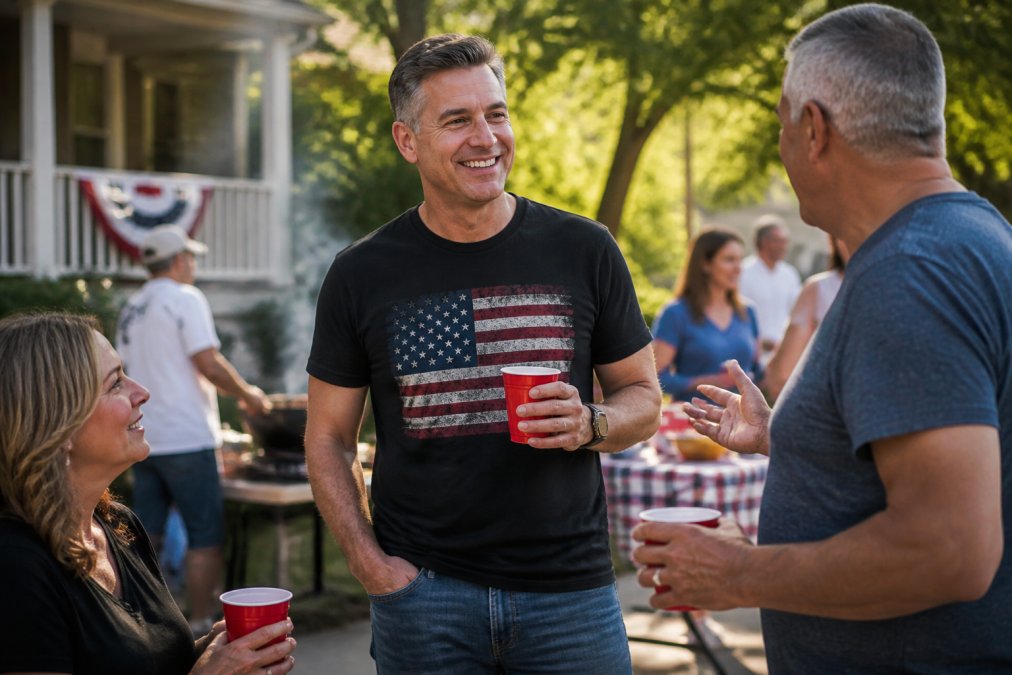
Professional adult wearing a bold patriotic graphic t-shirt in a casual community setting, demonstrating confident self-expression while maintaining approachable demeanor with neighbors
Many adults worry that wearing patriotic clothing will be perceived as aggressive or divisive. In practice, patriotic symbolism that doesn't reference specific candidates or parties reads as expression of American values rather than partisan advocacy.
The Nuance of 'Neutral' Clothing: What Actually Counts as Political
The term "neutral" in dress code contexts creates confusion. Employers often claim they enforce "neutral" dress codes while prohibiting political apparel, but what qualifies as political versus neutral varies widely.
A shirt with an American flag is patriotic but often considered neutral in workplace contexts. A shirt with a specific candidate's name is explicitly political. A shirt with a patriotic slogan like "Constitution" or "Liberty" falls between these poles.
Employers who want to enforce truly neutral dress codes typically prohibit all message-based apparel, not just political messaging. This avoids selective enforcement and the perception that they're targeting specific political viewpoints.
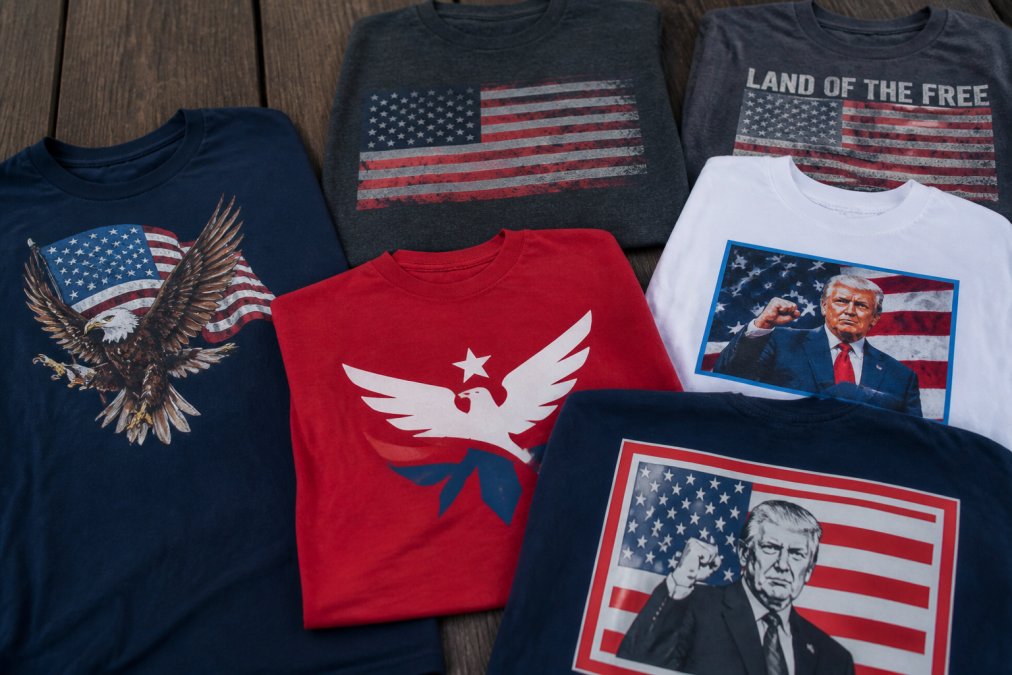
Close-up comparison of different patriotic and political t-shirt graphics showing the visual distinction between historic American symbols, abstract patriotic slogans, and explicit candidate names with campaign imagery
Digital vs. Physical Expression: Online vs. In-Person Political Speech
Political expression takes different legal forms online versus in physical spaces. In-person political expression through clothing receives First Amendment protection in public spaces but can be restricted in private workplaces and specific government-controlled areas like polling places.
Employers can monitor and restrict employee social media activity, particularly if it conflicts with company values or creates workplace conflict. However, the legal standards for employer discipline based on personal social media activity are stricter than for in-person workplace conduct.
For your own protection, maintain separation between your personal political expression and your professional identity. If you work in customer-facing roles or politically sensitive industries, be more cautious about both in-person political apparel and public political social media activity.
Your Employee Rights Checklist
- I have reviewed my employee handbook's dress code policy and understand what constitutes prohibited political apparel
- I understand the distinction between patriotic symbols (which may be permitted) and explicit candidate advocacy (which is typically prohibited)
- I know whether my employer's dress code applies to all message-based apparel or specifically to political messaging
- I understand that my employer can enforce dress code policies consistently, even if they restrict political expression
- I have asked HR directly if I'm uncertain whether a specific shirt violates my workplace dress code
- I understand that wearing prohibited political apparel to work can result in disciplinary action up to and including termination
- I know that my First Amendment rights protect political speech in public spaces but not in private workplaces
- I understand that I cannot be prohibited from wearing patriotic apparel featuring historic symbols or general patriotic slogans (unless my employer's policy specifically restricts all message-based clothing)
- I am aware that at polling places, I must comply with the 100-foot rule and cannot wear clothing with specific candidate names or ballot measure advocacy
- I understand that if I violate polling place dress code rules, I can be asked to change or cover my shirt before voting
Conclusion
Wearing political shirts involves understanding where your rights are protected and where employers and election officials can restrict your expression. The First Amendment protects political speech in public spaces, but private employers can enforce dress codes restricting political apparel, and election officials can prohibit electioneering within 100 feet of polling places.
The distinction between patriotic expression and explicit political advocacy is crucial. Patriotic apparel celebrating American values, history, and symbols is generally permitted in most workplaces and public settings. Clothing with specific candidate names, campaign materials, or explicit ballot measure advocacy faces greater restrictions.
For adults seeking to express patriotic values through clothing, Awake Republic LLC's streetwear collection combines bold American symbolism with contemporary design. The Brotherhood 100% Cotton Libertarian Streetwear T-Shirt and End The Endless Wars T-Shirt feature original graphics at $19.99 each. Start expressing your beliefs confidently by choosing patriotic apparel that aligns with your values and your environment.

Brotherhood 100% Cotton Libertarian Streetwear T-Shirt | Awake Republic®
Frequently Asked Questions
Can my employer fire me for wearing a political shirt to work?
Yes, if the shirt violates your workplace dress code policy. Private employers can enforce restrictions on political apparel, including candidate names, campaign materials, and explicit political slogans. However, they cannot discriminate based on the specific political viewpoint and must apply the policy consistently.
What happens if I wear a prohibited shirt to a polling place?
Poll workers can ask you to remove or cover the shirt before voting. If you refuse, you may be turned away from that polling location. You can return once you've changed clothes.
Is a patriotic shirt the same as a political shirt?
Not necessarily. Patriotic apparel celebrating American history, symbols, and values is generally considered patriotic expression rather than political advocacy. Clothing with specific candidate names, campaign slogans, or explicit ballot measure promotion is clearly political.
Can I be disciplined for political posts on my personal social media?
Employers have more limited authority to discipline employees for personal social media activity than for in-workplace conduct. However, some employers have social media policies restricting political posting, particularly if it could be attributed to the company or creates workplace conflict.
What does the 100-foot rule actually measure?
The 100-foot rule measures distance from the entrance to the polling place building, not from the parking lot. Check your state's election laws or ask poll workers about enforcement in your specific precinct.
How do I know if my shirt violates my workplace dress code?
Review your employee handbook's dress code policy section. If uncertain, ask your HR department directly. This protects you from disciplinary action and clarifies what your employer actually prohibits.
Can my employer restrict patriotic symbols like flags or eagles?
Only if their dress code policy prohibits all message-based apparel, applied consistently to all employees. If your employer allows other symbolic clothing, they cannot selectively prohibit patriotic symbols without legal exposure.
What's the difference between a patriotic slogan and a political slogan?
Patriotic slogans reference American values, history, or principles without endorsing a specific candidate or current ballot measure. Political slogans explicitly advocate for a candidate, party, or specific ballot measure. "Don't Tread On Me" is patriotic; "Vote for [Name]" is political.
Can I be required to remove my patriotic shirt at work?
Only if your employer's dress code policy specifically restricts it. Many employers distinguish between patriotic symbols (permitted) and explicit political advocacy (prohibited). Review your handbook or ask HR to clarify your employer's specific policy.
Do First Amendment rights protect me from employer discipline for wearing political shirts?
No. The First Amendment protects you from government censorship, not from private employer discipline. Private employers can restrict political expression in the workplace as part of their dress code policy. Government employers must respect First Amendment protections.
What should I do if my employer disciplines me for wearing a patriotic shirt?
Document the incident, including what you wore, when it occurred, and what your employer said. Review your employee handbook to determine if the discipline was consistent with the stated policy. If the policy was selectively enforced, consult an employment attorney about potential discrimination claims.
Frequently Asked Questions
Can I wear a political shirt to the polls on election day?
No. Federal law prohibits electioneering at polling places. Most states enforce a 100-foot boundary around polling locations where political apparel, including shirts with candidate names, partisan symbols, or campaign materials, is prohibited. The restriction applies to protect voter access and prevent voter intimidation. However, generic patriotic symbols without candidate advocacy may be permitted depending on your state statute—contact your local election office for clarification on specific designs.
Can my employer ban political shirts under dress code policy?
Yes, in most cases. Private employers have broad rights to establish dress code policies that restrict political expression at work. However, they cannot discriminate based on the viewpoint expressed or target specific political beliefs unfairly. Public employees have stronger First Amendment protections. Review your employee handbook for specific restrictions, and document any enforcement to ensure it's applied consistently across all employees regardless of political affiliation.
What's the difference between a political slogan and protected patriotic clothing?
Political slogans directly advocate for candidates, ballot measures, or specific parties (e.g., 'Vote for [Candidate]'). Patriotic symbols and general political statements about governance or values typically receive stronger protection under the First Amendment. A shirt with the American flag or 'We the People' is generally safer than one naming a candidate. State statutes vary, so context matters—the same design may be prohibited at a polling place but protected in other settings.
How do I know if my political shirt will cause workplace conflict?
Review your employee handbook and ask HR directly about dress code enforcement before wearing political apparel to work. Consider your workplace culture and whether similar political expression is already present. Bold, provocative designs intended to spark conversation may invite unwanted debate in professional settings. If you value self-expression, gauge whether your workplace respects independent thought or enforces strict neutrality. Many professionals wear patriotic clothing without issue when the design emphasizes unity rather than divisiveness.