

How to Build a Sustainable Capsule Wardrobe That Lasts
Last Updated: November 1, 2026
Quick Summary
To build a sustainable capsule, start by decluttering what you already own and sorting it into keep, donate, sell, and recycle piles before buying anything. Then define your personal style, choose a cohesive color palette, and buy fewer well-made pieces you can repair and rewear.
- Sort your closet into four piles: keep, donate, sell, and recycle before shopping.
- A common palette framework is a 60/30/10 split of neutrals and accents.
- A worked example breaks a 24-piece capsule into tops, bottoms, layers, shoes, and accessories.
- Cost per wear divides a piece's price by the number of times you wear it.
- Wash cold, air-dry, and store knits folded to make garments last longer.
Table of Contents
- Step 1: Assess and Declutter Your Current Wardrobe
- Step 2: Define Your Personal Style and Lifestyle Needs
- Step 3: Choose a Cohesive Color Palette and Capsule Size
- Capsule Wardrobe Essentials: Versatile Basics and Statement Pieces
- Your Minimalist Wardrobe Checklist Before You Buy Anything
- A Sustainable Fabrics Guide for Buying Pieces That Last
- Capsule Wardrobe Outfit Ideas: Mix, Match, and Layer
- Start Your Capsule With an Awake Republic Tee
- Frequently Asked Questions
Step 1: Assess and Declutter Your Current Wardrobe
A sustainable capsule wardrobe starts with what you already own, not with a shopping cart, and that is the first rule of building a sustainable capsule.
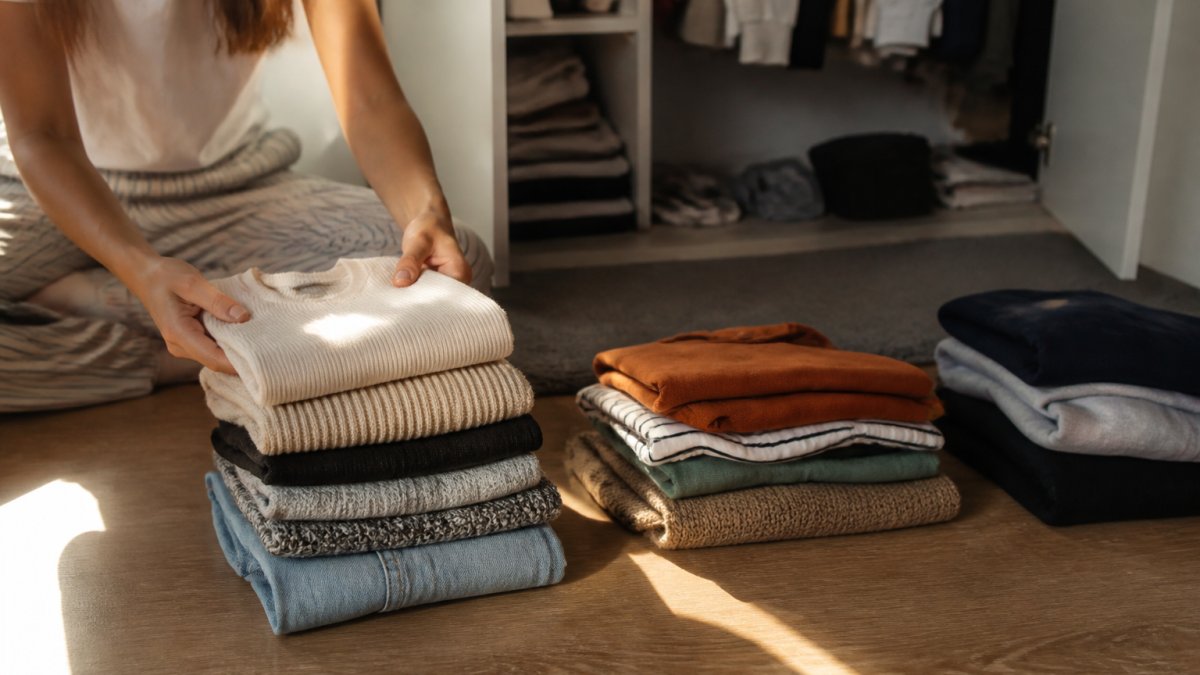
The Keep, Donate, Sell, Recycle Sort
Work through the piles with clear rules:
- Keep: Fits well, feels comfortable, worn in the last year.
- Donate: Good condition, but doesn't fit your body or style.
- Sell: Brand-name pieces in great shape. Resale sites and consignment shops work here.
Be honest about the "keep" pile. If a piece needs repairs you'll never do, it's not a keeper.
Step 2: Define Your Personal Style and Lifestyle Needs
Personal style is the pattern of what you actually reach for, not what you wish you wore.
Then map your real week. A remote worker needs different pieces than someone in an office five days a week. Write down the situations you dress for most, and build around those.
This is where most capsule guides go wrong. They hand you a generic list. Your lifestyle needs are the actual blueprint.
Step 3: Choose a Cohesive Color Palette and Capsule Size
A cohesive color palette is the load-bearing wall of a capsule wardrobe. If every piece works with at least two others, you can build dozens of outfits from a small set. If it doesn't, you own a closet full of orphans no matter how many pieces you keep.
Build the Palette in Two Layers
Start with neutrals, then add accents. A common practitioner framework is a 60/30/10 split:
- 60% core neutrals: black, navy, charcoal, white, cream, tan, or olive. Pick two or three, not all seven. These are your pants, tees, and outerwear.
- 30% secondary neutrals: a lighter or darker shade that bridges the core. If your core is navy and charcoal, a light gray or ecru fills this slot.
- 10% accents: one or two colors you actually love wearing. Burgundy, rust, forest green, or a bright you reach for repeatedly.
Test the palette before you commit. Lay your keep-pile pieces on the bed and check whether any two tops can pair with any two bottoms. If a piece only works with one other item, it's an accent at best and a mistake at worst.
How Many Pieces Do You Actually Need?
There is no required piece count. The internet is full of "capsule wardrobe rules" that prescribe exactly 33 or 37 items, but a workable capsule depends on your life.
A useful starting ratio is roughly 70% versatile basics and 30% statement or personality pieces. Start at the low end if you're new. You can always add, and adding deliberately beats adding in a panic.
A Worked Example: 24-Piece Capsule
Here's how a 24-piece capsule might break down for a business-casual wardrobe in a four-season climate:
- Tops (8): 4 plain tees, 2 button-downs, 1 knit sweater, 1 graphic or statement tee
- Bottoms (5): 2 pairs of jeans (one dark, one light), 1 pair of chinos, 1 pair of tailored trousers, 1 pair of shorts
- Layers (4): 1 zip hoodie, 1 cardigan or overshirt, 1 lightweight jacket, 1 heavier coat
That's 24 pieces. Run the pairing test: each top should work with at least three bottoms, and each layer should work over at least four tops. If it does, you have a functioning capsule. If it doesn't, swap the outlier for something that pairs more freely.
Here is how a 24-piece capsule might break down for a business-casual wardrobe in a four-season climate.
Category |
Pieces |
Breakdown |
|---|---|---|
Tops |
8 |
4 plain tees, 2 button-downs, 1 knit sweater, 1 statement tee |
Bottoms |
5 |
2 jeans, 1 chinos, 1 tailored trousers, 1 shorts |
Layers |
4 |
1 zip hoodie, 1 cardigan or overshirt, 1 lightweight jacket, 1 heavier coat |
Shoes |
3 |
1 sneaker, 1 loafer or boot, 1 sandal or slip-on |
Dresses or one-piece options |
2 |
Optional, but useful for low-effort days |
Accessories |
2 |
1 belt, 1 bag |
Capsule Wardrobe Essentials: Versatile Basics and Statement Pieces
The capsule wardrobe essentials list is short: plain tees, one or two pairs of well-fitting pants, a layering piece, and shoes that handle most days. These are your versatile basics.
Statement pieces carry the personality. A bold graphic tee or a hoodie with a design you actually believe in does more work than five neutral tops.
That balance is the whole system. Basics hold the outfit together. Statement pieces make it yours.
Your Minimalist Wardrobe Checklist Before You Buy Anything
A minimalist wardrobe checklist stops impulse buying. Run every potential purchase through it first:
- Does it match my color palette?
- Can I name three outfits it completes?
- Is the fabric durable enough to last?
If any answer is no, skip it.
Cost per Wear: A Budget That Rewards Quality
Cost per wear is the price divided by the number of times you'll wear a piece. A $20 shirt worn twice costs $10 per wear. A better-made piece worn many more times costs less per wear.
Awake Republic® Logo Streetwear T-Shirt (100% Cotton) →
That math changes how you shop. It rewards durability over a low sticker price.
A Sustainable Fabrics Guide for Buying Pieces That Last
To choose garments that actually last, compare four things: fiber impact, construction durability, repairability, and care requirements. Most capsule guides stop at "buy quality," which tells you nothing you can act on. This section gives you a framework.
1. Fiber Impact: Compare, Don't Worship
No fiber is universally sustainable. Each has trade-offs, and the honest move is to compare them on the dimensions that matter for your use case.
- Cotton: Breathable and durable, but conventional cotton is water- and pesticide-intensive. Organic cotton reduces chemical load but still uses significant water. Combed and ring-spun cotton feels smoother and pills less than basic cotton.
- Linen: Made from flax, which grows with less water and fewer inputs than conventional cotton. Strong and long-lasting, but wrinkles and costs more. A linen piece that survives a decade can beat a cheap cotton piece replaced every year.
- Wool: Durable, odor-resistant, and repairable. Needs less frequent washing, which extends its effective life. Look for tighter knits and clean seams; loose, fuzzy knits pill fast.
A practical rule: choose natural fibers for next-to-skin pieces and durable synthetics only where performance justifies them (rain shells, athletic wear). Avoid blends that mix natural and synthetic fibers when you can, because they're harder to repair and nearly impossible to recycle.
2. Construction Durability: Read the Seams
Fiber is half the story. Construction decides whether a garment survives its first year.
- Seams: Look for tight, even stitching with no loose threads. Flatlock or reinforced seams at stress points (armholes, crotch, pockets) last longer.
- Fabric density: Hold the fabric up to light. If you can see through it easily, it will likely pill, stretch, or tear. Dense weaves and tight knits hold shape.
- Hardware: Metal zippers, reinforced buttons, and bar-tacked stress points outlast plastic zippers and single-stitched buttons.
how to spot high quality streetwear walks through the exact indicators to check before you commit.
3. Repairability: Can It Be Fixed?
A sustainable garment is one you can mend. Before buying, ask:
- Are the seams accessible for a tailor or home repair?
- Is the fabric a simple weave or knit that patches cleanly?
- Are the buttons and zippers standard sizes you can replace?
Simple construction in solid colors is more repairable than complex construction in prints. That's a sustainability argument for basics.
4. Care Requirements: The Hidden Lifecycle Cost
How you wash a garment determines how long it lasts. Hot water, high heat, and frequent washing break down fibers faster than wear does.
- Wash cold and less often. Most garments don't need a wash after every wear.
- Air-dry when possible. Dryer heat is one of the fastest ways to shrink, pill, and wear out fabric.
- Use a mesh bag for synthetics to help catch fibers in the wash.
Beyond Buying: Repair, Resale, and End-of-Life
Sustainability doesn't end at the register. Plan for what happens after a piece leaves your rotation.
- Repair first. A tailor can replace a zipper, reinforce a seam, or patch a knee for far less than a replacement costs. Learn one basic stitch and you can fix hems and buttons yourself.
- Resell what still has life. Consignment shops and resale platforms extend a garment's useful life and recoup part of your cost.
- Donate thoughtfully. Only donate items in wearable condition. Torn or stained items burden donation centers.
Buy fewer pieces made well, care for them, and repair them before replacing them. That is the core of a sustainable wardrobe, and it's measurable in cost per wear rather than marketing claims.
Capsule Wardrobe Outfit Ideas: Mix, Match, and Layer
Capsule wardrobe outfit ideas come down to layering. A base layer tee, a middle layer like a hoodie, and an outer layer for weather gives you three looks from three pieces.
Try these combinations:
- Plain tee plus zip hoodie plus jeans
- Graphic tee alone with chinos
- Hoodie over a tee with shorts
Mix and match the same pieces across the week. For more combinations, browse Minimalist Streetwear Outfits For Men. Fewer items, more outfits.
Start Your Capsule With an Awake Republic Tee
The easiest first move is a single versatile tee. Awake Republic builds original graphic tees and hoodies with bold American symbolism, made to start conversations rather than blend in.
The 100% combed and ring-spun cotton tee is pre-shrunk and side-seamed, with a 4.2 oz./yd.² (142 g/m²) fabric weight. At $19.99, it is priced at $19.99. Pair it with the Respect The Locals zip hoodie as your middle layer.
Frequently Asked Questions
How many pieces should a sustainable capsule wardrobe have?
Capsule sizes vary with your needs, so there is no single correct count. The number matters less than the ratio: aim for roughly 70% basics and 30% statement pieces. Count tops, pants, layers, shoes, and outerwear, but leave out underwear, socks, workout gear, and sleepwear. Start at the low end if you are new to this, then add pieces only when a real gap shows up in your weekly outfits.
What are the essentials for a sustainable capsule wardrobe?
Capsule wardrobe essentials are the pieces you reach for weekly: two or three neutral tops, one or two pairs of well-fitting pants, a middle layer like a hoodie or sweater, an outer layer, and shoes that handle most days. Add one or two statement pieces that carry your personal style, such as an original graphic tee. A useful test for any essential is whether it works with several other pieces you own.
How do you build a capsule wardrobe from clothes you already own?
Pull everything out, then sort into keep, donate, sell, and recycle. Keep items that fit well, feel comfortable, and match your color palette. Build outfits from what survives before buying anything new. Many people already own much of a working capsule and only need to fill a few gaps. Write those gaps on a minimalist wardrobe checklist and shop only from that list, which stops impulse buys and keeps the budget honest.
What fabrics should you look for in sustainable clothing?
Look for durable natural or low-impact fibers: combed and ring-spun cotton, linen, wool, and Tencel. Check fabric weight, since heavier fabrics generally feel more substantial than thin knits. Pre-shrunk and side-seamed construction are features to look for in a garment. Avoid blends that pill or stretch out after a few washes. A sustainable fabrics guide helps, but the real test is cost per wear: divide the price by the number of times you will actually wear it.
Building a capsule takes discipline, and the hardest part is resisting the urge to buy more than you need. Awake Republic makes that easier with pieces designed to last and mean something. Start with the Awake Republic logo tee and build outward from there.

